PFAS belongs in the Sarasota County water conversation, especially around North Port. The right response is not panic and it is not a generic equipment bundle. It is a clear sequence: identify the water source, read the public report when the home is on city water, use the right laboratory test when a health-related question exists, and choose treatment only after the concern is named.
North Port city water and North Port private wells are different decisions. A regulated utility publishes a Consumer Confidence Report. A private well does not have that same routine public monitoring, so the homeowner carries more responsibility for testing and maintenance.
Why PFAS matters here
PFAS are persistent manufactured chemicals associated with products such as stain-resistant materials, industrial uses, and some firefighting foams. EPA's PFAS drinking-water rule regulates PFOA, PFOS, PFHxS, PFNA, HFPO-DA, and a hazard index for mixtures of certain PFAS in public water systems.
The headline number most homeowners hear is 4.0 parts per trillion for PFOA and 4.0 parts per trillion for PFOS. That is the enforceable maximum contaminant level for each compound under EPA's rule. Public water systems have monitoring and compliance deadlines, so the current report and future updates both matter.
Sarasota County also has local PFAS attention because Suncoast Waterkeeper has been running public education and sampling work through its Forever Free program. Their materials describe regional concern in Sarasota and Manatee Counties and explain why North Port became an early focus for drinking-water testing. That is useful local context, but it should be read as independent/community sampling rather than a replacement for a utility report or a household-specific laboratory result.
What North Port city-water customers should do first
If your home is connected to North Port Utilities, start with the current Consumer Confidence Report. The City says the 2025 report contains source, quality, and treatment information and indicates that North Port city drinking water meets and exceeds federal and state drinking-water standards.
That does not mean every homeowner has the same objective. A public report describes the utility system. A home tap can still be affected by plumbing, fixtures, point-of-entry equipment, or a customer's preference for extra drinking-water treatment.
Use this order:
- Confirm whether the property is on North Port Utilities or a private well.
- Read the current North Port Consumer Confidence Report.
- Name the concern: PFAS, taste, sulfur odor, hardness, tannins, iron, sediment, or bacteria.
- Use a certified laboratory for health-related chemical or microbiological questions.
- Match treatment to the result and verify the equipment certification.
What private-well owners should treat differently
Private wells are not federally regulated like public water systems. The owner is responsible for deciding what to test, how often to test, and whether treatment is working.
In North Port and surrounding Sarasota County, well-water calls often include problems that are separate from PFAS:
- Hydrogen sulfide or sulfur odor: rotten-egg smell that can involve the aquifer, plumbing, or water heater.
- Tannins: yellow or tea-colored water from organic material in shallow or surface-influenced water.
- Hardness: calcium and magnesium scale from Florida geology, sometimes severe enough to damage fixtures and appliances.
- Iron or manganese: staining, metallic taste, black residue, or filter fouling.
- Bacteria or nitrates: health-related concerns that require laboratory testing, not a sales demonstration.
PFAS can be added to the laboratory panel when the property, source water, nearby land use, or homeowner concern justifies it. Do not assume a water softener handles that question. A softener is for hardness; PFAS treatment is a different design choice.
Which home treatments are relevant for PFAS?
EPA identifies several treatment technologies for PFAS, including granular activated carbon, ion exchange, reverse osmosis, and nanofiltration. For a homeowner, the most common practical discussion is usually a certified point-of-use drinking-water system at the kitchen tap, often reverse osmosis, or a properly specified carbon system.
Certification matters. EPA advises homeowners to look for independent certification for PFAS reduction, including NSF/ANSI 53 for certain carbon systems and NSF/ANSI 58 for reverse-osmosis drinking-water systems. A product label should name the reduction claim; the word "filter" alone is not enough.
Maintenance matters just as much. A neglected filter can lose performance. If the system is being used for a health-related reduction claim, filter-change intervals, membrane service, prefilter condition, flow rate, and post-install verification should be treated as part of the protection plan.
Why Tampa is a different RO conversation
Tampa-area homes often start from a different place. Many customers are on municipal water, and MacDill Air Force Base receives drinking water from the City of Tampa rather than using base groundwater for drinking. MacDill has publicly discussed PFOS/PFOA history tied to firefighting foam use on base, while also noting that base groundwater is not used for drinking water.
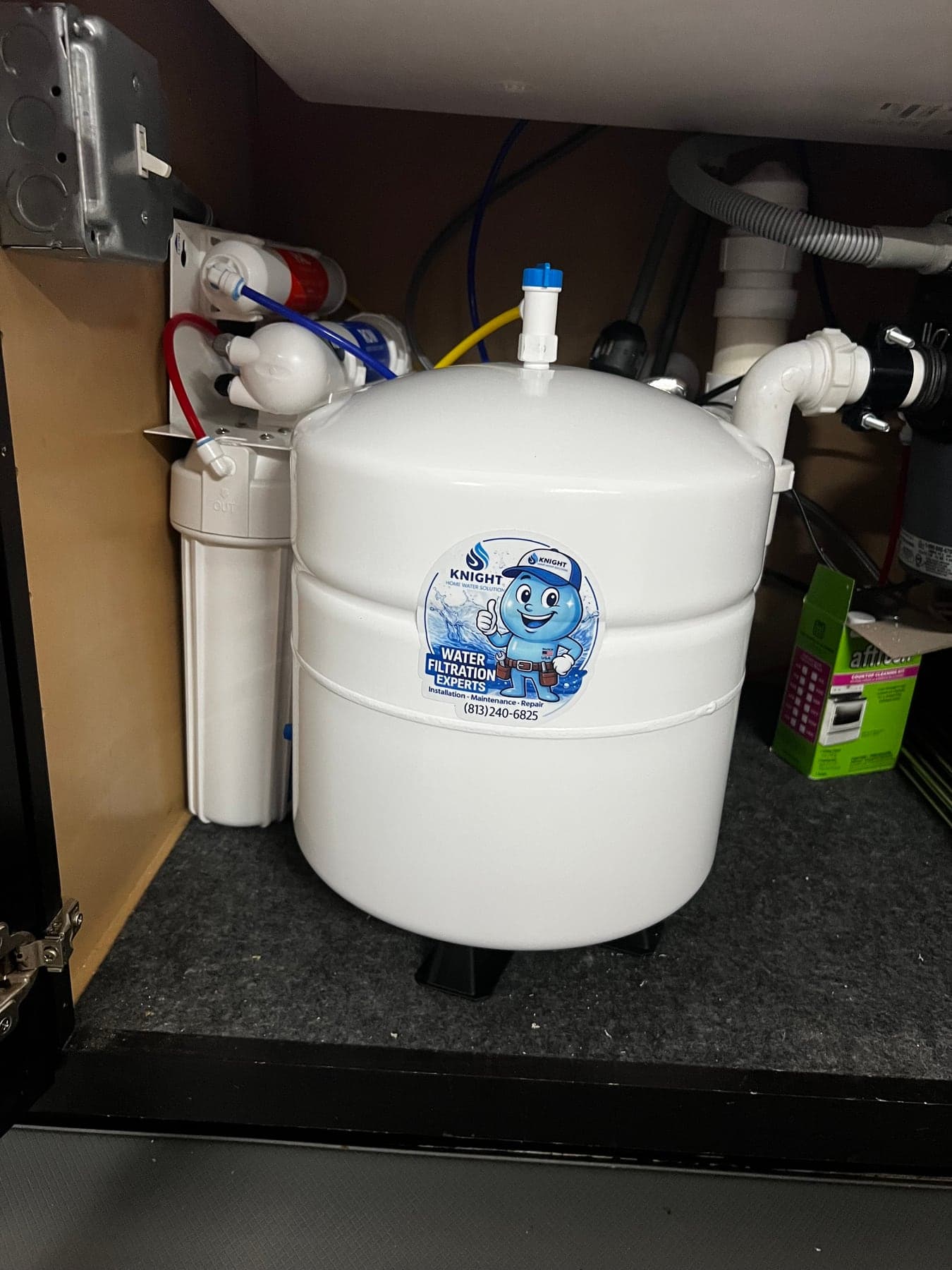
That makes the Tampa recommendation more focused: a properly selected reverse-osmosis drinking-water system is usually a point-of-use choice for the kitchen tap, not a claim that every city-water home needs whole-house PFAS treatment. It can make sense for drinking and cooking water when a household wants extra reduction capability, lower dissolved solids, or better taste backed by a specific certification.
For whole-home issues in Tampa, hardness and chlorine taste are often separate conversations. A softener can address scale. Carbon filtration can address taste and odor. RO is for the drinking tap.
What Knight recommends before equipment
A responsible recommendation should separate three questions:
- Is this a regulated public-water report question? Read the utility report and current notices.
- Is this a household water-quality question? Test the actual tap or well.
- Is this an equipment-selection question? Choose certified treatment for the named concern.
Knight Home Water Solutions can help with the equipment-planning side: source identification, hardness screening, taste and odor review, plumbing walkthrough, and treatment options for softening, filtration, RO, UV, iron, and sulfur. For PFAS or any health-related chemical claim, use appropriate laboratory results and select equipment with the exact certified reduction claim.
Request a free in-home water test if you want help separating hardness, sulfur, tannins, city-water taste, and drinking-water filtration options before you buy a system.