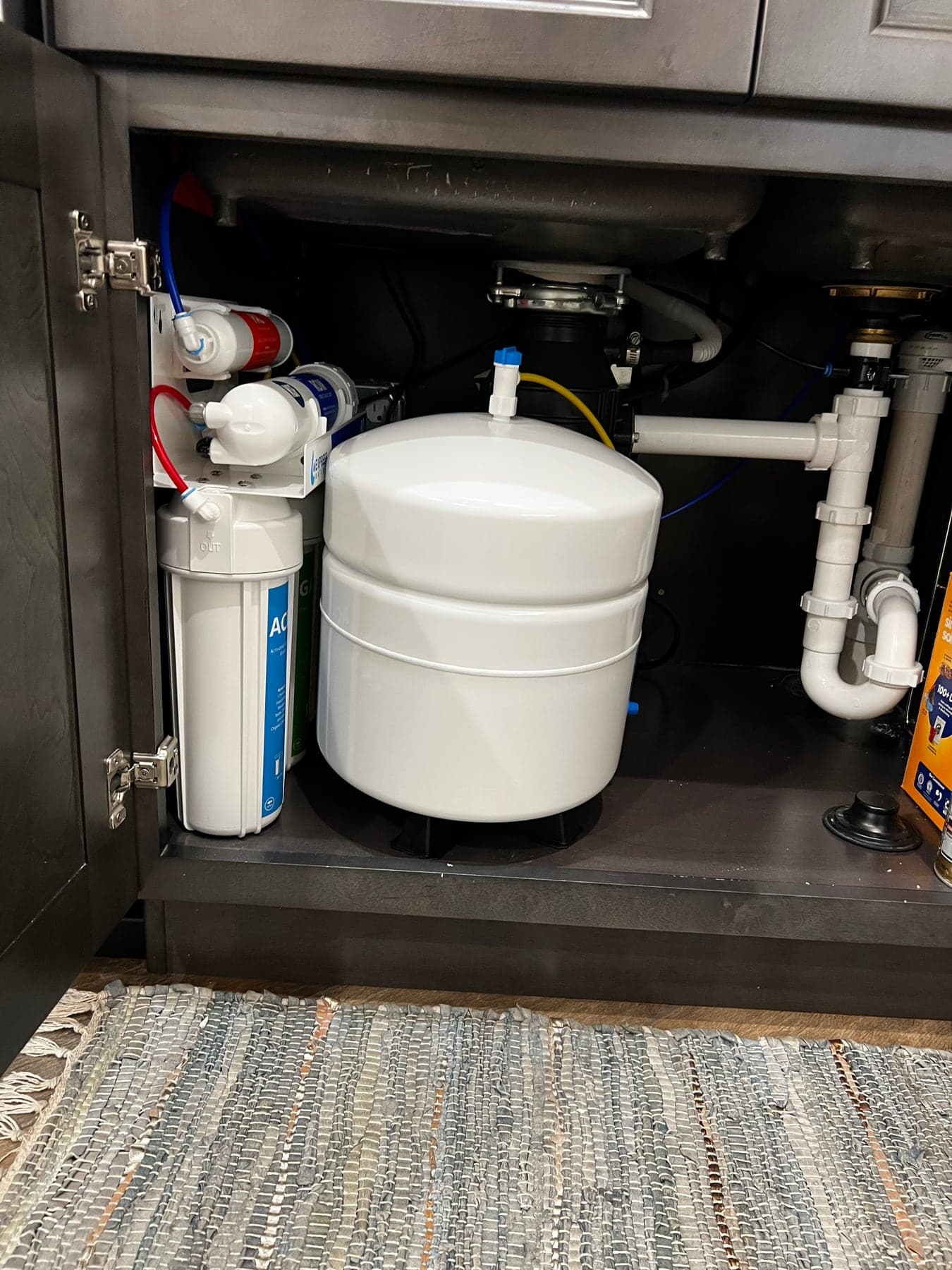
An under-sink reverse-osmosis system can provide a dedicated supply of treated drinking and cooking water. It is not a whole-house softener, and it is not proof that municipal water is unsafe. It is a point-of-use treatment choice for households that want a specific taste profile or verified reduction of contaminants listed on the system's certification.
Tampa homeowners should compare RO systems by certified performance, efficiency, maintenance, and fit with the home's water—not by a blanket “removes 99%” claim. The percentage is incomplete unless it names the substance, test standard, starting concentration, and operating conditions.
What is reverse osmosis?
Reverse osmosis uses water pressure to move water through a semipermeable membrane. Water that passes through becomes the treated stream. Water carrying concentrated dissolved material leaves as the reject or concentrate stream.
The EPA's drinking-water technology overview explains that RO can remove a broad range of substances, including many dissolved solids, inorganics, radionuclides, and synthetic organic chemicals. It also notes tradeoffs: membrane fouling, pressure requirements, pretreatment needs, concentrate disposal, and possible changes in treated-water pH.
A typical residential point-of-use system may include:
- a sediment prefilter;
- one or more carbon prefilters;
- the RO membrane;
- a storage tank or tankless delivery system;
- a post-carbon polishing filter; and
- a dedicated faucet.
Each stage has a job. The membrane is only one part of the treatment train.
Does Tampa tap water require RO?
No universal rule says every Tampa home requires reverse osmosis. Public water systems must meet federal and state drinking-water requirements, and the City of Tampa publishes annual test results in its Consumer Confidence Report.
The city's 2025 Water Quality Report summarizes regulated monitoring and additional reporting, including PFAS data. Homeowners should read the current report rather than relying on a social-media claim or a demonstration that simply changes the water's color.
Tampa also has a military-base context that should be handled carefully. MacDill Air Force Base has publicly explained that PFOS/PFOA concerns on base are tied to historical firefighting foam use, and that base residents and employees receive drinking water from the City of Tampa rather than base groundwater. That makes RO a targeted drinking-water upgrade for many Tampa households, not a blanket claim that all city water is unsafe.
Households still choose RO for several legitimate reasons:
- they prefer the taste of low-mineral drinking water;
- they want a dedicated system certified for a particular reduction claim;
- their plumbing or private well creates a tap-specific concern;
- they want an alternative to recurring bottled-water purchases; or
- they need a treatment barrier recommended from appropriate test results.
That is a preference-and-performance decision, not a declaration that every gallon of city water is unsafe.
For Sarasota County and North Port concerns, especially where PFAS or private wells are part of the question, read our North Port PFAS water guide.
What can reverse osmosis reduce?
RO can reduce many dissolved contaminants, but no responsible answer should stop there. The exact reduction depends on membrane design, feed-water conditions, pretreatment, pressure, recovery rate, maintenance, and the complete system certification.
The EPA's point-of-use RO guidance identifies potential reductions including lead, volatile organic compounds, PFAS, arsenic, bacteria, and viruses. “Potentially” is important. A homeowner should verify that the exact model carries a certified claim for the substance of concern.
NSF explains that NSF/ANSI 58 applies to reverse-osmosis drinking-water treatment systems. A system certified to Standard 58 is not automatically certified for every possible reduction claim. Look for both the standard and the named contaminant reduction on the product listing.
What does reverse osmosis not guarantee?
RO does not guarantee perfect water, permanent performance, or removal of every substance. A neglected system can lose flow, foul, leak, or deliver water that no longer meets the expected performance.
Common limitations include:
- No universal removal list. Claims are model-specific.
- Maintenance is mandatory. Filters and membranes have finite service lives.
- Water pressure matters. Low pressure can reduce production and efficiency.
- Pretreatment may be necessary. Hardness, iron, sediment, or disinfectants can affect components.
- Microbial safety needs system-level thinking. A certification, sanitary installation, storage-tank condition, and scheduled service all matter.
- RO is usually point-of-use. It treats water at one faucet rather than every shower, appliance, and hose bib.
If a private well may be contaminated with pathogens or chemicals, use a state-certified laboratory and local health guidance. Do not select treatment only from taste, odor, or a basic sales test.
How much water does an RO system send to the drain?
Every RO system creates concentrate water. The ratio of treated water to reject water varies substantially by design and operating conditions.
Older or inefficient units can send several gallons to drain for each gallon of treated water. Newer systems can be materially more efficient. The EPA's WaterSense program now labels qualifying point-of-use RO systems that meet its efficiency and performance specification. The EPA notes that labeled systems must produce at least 0.3 gallons of treated water for each gallon entering the unit, while meeting contaminant-reduction and other performance requirements.
When comparing systems, ask for:
- the tested recovery or efficiency rating;
- the conditions used to produce that rating;
- whether the model is WaterSense labeled;
- expected daily production at the home's pressure and temperature;
- tank refill time; and
- whether reject water goes directly to drain.
Efficiency belongs in the purchase decision, especially during drought restrictions and in households that use substantial drinking and cooking water.
Does RO remove healthy minerals too?
RO lowers many dissolved minerals along with unwanted substances. Most people obtain the majority of essential minerals from food, but taste preferences vary. Some systems use a remineralization stage after the membrane to change flavor or alkalinity.
A remineralization cartridge is not automatically better or necessary. It is another consumable stage with a specific purpose. Ask what media it contains, what it adds, how long it lasts, and whether the claim is independently verified.
If a person has a medical condition, dietary restriction, infant-formula question, or other health concern, treatment choices should be discussed with an appropriate healthcare professional. A water equipment provider should not replace medical advice.
How is RO different from a softener or whole-house filter?
The systems solve different problems:
- A water softener treats hardness minerals throughout the home.
- A whole-house filter uses selected media for specific point-of-entry concerns.
- A reverse-osmosis system produces lower-dissolved-solids water at a dedicated drinking tap.
- A UV purification system uses ultraviolet light for microbial disinfection and normally requires appropriate prefiltration.
A household may use more than one process because no single technology does every job. For example, hardness treatment can help protect an RO membrane from scaling, while carbon pretreatment can protect certain membrane materials and improve taste. The sequence must follow the selected equipment's requirements.
How often does an RO system need service?
Follow the manufacturer's schedule, then adjust based on actual feed-water quality and use. Prefilters and postfilters are generally changed more often than the membrane. A storage tank, faucet, tubing, drain connection, and sanitization procedure also deserve attention.
Signs service may be due include:
- slower flow or longer tank refill time;
- a noticeable change in taste or odor;
- a rising total-dissolved-solids reading compared with the established baseline;
- unusual cycling, drain flow, or noise;
- a filter-change indicator; or
- reaching the documented service interval.
Do not wait for obvious failure if the system is being relied on for a specific reduction claim.
How should Tampa homeowners choose an RO system?
Begin with the household's actual objective. “Better water” is too vague to size or certify a system.
Use this checklist:
- Review the current utility report or private-well laboratory results.
- Name the taste, dissolved-solids, or contaminant concern.
- Verify the model's certification for that exact reduction.
- Compare efficiency, production rate, pressure needs, and storage.
- Confirm replacement-filter availability and annual ownership cost.
- Plan for sanitary installation, leak protection, and future service.
- Establish a post-installation performance baseline.
Knight Home Water Solutions can test the home's water, examine the plumbing and pressure, and explain whether RO is appropriate or whether another treatment stage should come first. Request a free in-home water test when you want a recommendation built around your tap rather than a generic equipment bundle.