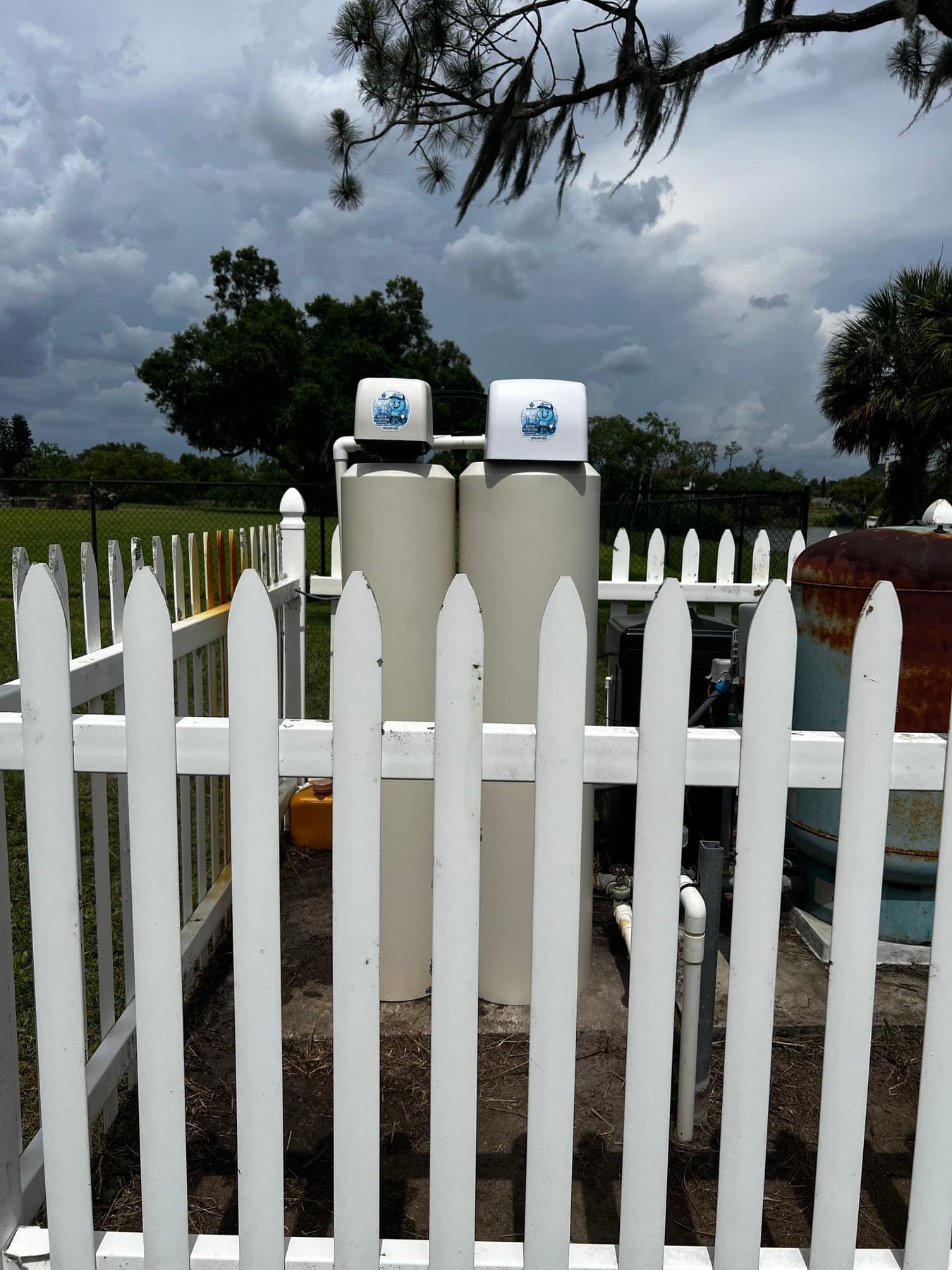
A water softener and a whole-house water filter are not interchangeable. A softener targets hardness minerals. A filter targets specific particles, tastes, odors, or chemicals according to its media and certified claims. Some Tampa Bay homes benefit from both, but the right answer begins with the water—not a package of equipment.
That distinction matters locally. The City of Tampa reports that its drinking water hardness can fluctuate from roughly 140 to 300 parts per million, or 8 to 17 grains per gallon, depending on season and source conditions. The city also makes clear that hard water is generally acceptable to drink; softening is mainly about scale, cleaning, feel, and appliance protection. See the city's current water hardness guidance for the source numbers and cautions.
What does a water softener actually do?
A water softener primarily reduces calcium and magnesium, the dissolved minerals responsible for hard-water scale. Most residential systems use ion exchange: resin captures hardness ions and exchanges them for sodium or potassium ions before periodically regenerating.
The CDC's home water treatment overview describes softeners as systems for removing minerals, especially calcium and magnesium. It also states an important limitation: standard softeners do not remove parasites, bacteria, or viruses.
Softening is usually considered when a home has measurable hardness and symptoms such as:
- white scale on faucets, shower glass, and heating elements;
- soap or shampoo that lathers poorly;
- mineral spots on dishes and fixtures;
- repeated scale-related maintenance on water heaters or appliances;
- laundry that feels stiff after washing; or
- a preference for the feel and cleaning performance of softened water.
The goal is not to label the utility water unsafe. It is to control minerals that create operational and comfort problems inside the house.
What does a whole-house water filter do?
A whole-house filter treats water at the point where it enters the home, but its performance depends entirely on the media and verified reduction claims. “Whole-house filter” describes where treatment occurs—not a universal list of contaminants it removes.
Examples include sediment filters for suspended particles and carbon-based systems for certain taste, odor, and disinfectant concerns. Other media may be selected for a defined chemical or aesthetic issue. A filter should never be assumed to remove every contaminant merely because it is large or installed at the main line.
NSF's explanation of residential treatment standards helps clarify the labels:
- NSF/ANSI 42 addresses aesthetic claims such as chlorine, taste, and odor reduction.
- NSF/ANSI 53 addresses specified contaminants with health effects.
- NSF/ANSI 44 applies to residential cation-exchange water softeners.
- NSF/ANSI 58 applies to reverse-osmosis drinking-water systems.
A certification number is not a promise that a product removes everything covered by that standard. Check the product's exact certified reduction claims and operating limits.
Do Tampa homes need a softener, a filter, or both?
Many Tampa homes start with a hardness problem, a taste or odor concern, or both. A measured hardness problem points toward softening. An unwanted disinfectant taste or another filterable concern may point toward correctly selected filtration. When the concerns are separate, two treatment stages may be appropriate.
Use this decision pattern:
- Hardness only: Consider a properly sized water softener.
- Taste, odor, chlorine, or sediment only: Consider filtration selected for that exact concern.
- Hardness plus a filterable concern: A softener and whole-house filter may work together.
- Drinking-water concern at one faucet: A point-of-use system, such as reverse osmosis, may be more targeted than treating every gallon entering the house.
- Private-well water: Test for iron, sulfur conditions, microbes, pH, and other local concerns before designing any system.
The most important word is “may.” Water treatment should be sized from evidence, not from a neighborhood assumption.
Which system goes first in the treatment train?
There is no single sequence that fits every home. The correct order depends on raw-water chemistry, flow demand, pressure, media requirements, and the equipment manufacturer's specifications.
A typical design may place sediment or problem-specific pretreatment before equipment that needs protection from fouling. In other cases, carbon filtration, softening, iron treatment, or disinfection must be arranged differently to avoid damaging media or reducing performance. Well-water systems can require additional contact tanks, oxidation, retention, or prefiltration.
This is why buying individual components first and planning the order later can become expensive. The treatment stages should be designed together, with service access, drain requirements, bypasses, and maintenance included from the beginning.
Does a softener also filter chlorine or contaminants?
Do not assume it does. Standard softening resin is selected for ion exchange, not for broad chemical filtration or disinfection. Some combination products contain multiple media, but their capabilities still depend on the specific design and verified claims.
Likewise, a carbon filter does not soften water simply because it improves taste. If hardness minerals remain, scale can continue even when the water smells or tastes better.
The safest rule is simple: one symptom does not prove one contaminant, and one tank does not automatically perform every treatment process.
Is softened water safe to drink?
Hard water is not automatically unsafe, and softened water is not automatically healthier. The City of Tampa notes that ion-exchange softeners can increase sodium in treated water. People on sodium-restricted diets should discuss their situation with a healthcare professional.
Some households choose to soften the hot-water line or most of the home while supplying a separate unsoftened or reverse-osmosis drinking tap. The right plumbing arrangement depends on the household, existing piping, water chemistry, and selected equipment.
For any health-related contaminant concern, use appropriate laboratory testing and treatment certified for the specific claim. An in-home hardness or chlorine screening is useful for equipment planning, but it is not a substitute for a state-certified laboratory when health and safety are at issue.
How should a Tampa homeowner compare systems?
Start with measurable requirements and lifecycle ownership—not tank size or a promotional discount.
Ask each provider to document:
- the raw-water test results used for the recommendation;
- the treatment objective for each piece of equipment;
- service flow rate and household sizing assumptions;
- the exact media and certified reduction claims;
- regeneration or backwash frequency;
- salt, filter, electricity, and water consumption;
- maintenance intervals and replacement costs;
- warranty coverage, exclusions, and who performs service; and
- what post-installation test confirms the system is working.
The EPA notes that softener regeneration can consume meaningful water and salt. Its water-efficient softener guidance recommends considering demand-initiated regeneration and maintaining the equipment so it does not cycle more often than necessary.
What is the best first step?
Test the water and define the problem in plain language. Knight Home Water Solutions begins with the home's source, symptoms, plumbing, household demand, and measured conditions. We then explain whether the evidence supports a water softener, whole-house filtration, both systems, or no immediate equipment change.
For municipal water, also read the utility's current Consumer Confidence Report. The City of Tampa's annual reports explain the source water, regulated testing, and detected levels. That report and a tap-side evaluation answer different questions; together they create a better treatment plan.
If you want a recommendation tied to your actual home, request a free in-home water test. The objective is not to install the most equipment. It is to install the treatment that matches the water and can be maintained for the long term.